|
"When we strive to pass wilderness legislation, what we are really engaged in is democracy at work."
- Bart Koehler
Read an important message about patriotism and the purpose of wilderness from our friends at the Wilderness Support Center in Colorado.
|
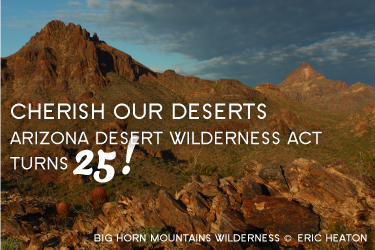
Cherish our Desert Landscapes
Celebrating 25 years of the Arizona Desert Wilderness Act of 1990
Quicklinks: Suggested Fall Explorations | Wilderness Areas Designated Under the 1990 Act | Additional Resources
This year we celebrate the 25th anniversary of the Arizona Desert Wilderness Act of 1990 — a sweeping piece of legislation that designated more than 1.1 million acres of wilderness on Bureau of Land Management (BLM) and U.S. Fish and Wildlife Refuge lands in Arizona. And many of these special wild places are just a stone’s throw from metropolitan Phoenix and Tucson.
We owe much gratitude for what we celebrate today to dedicated citizen volunteers and to the tireless efforts of brothers and public officials, Stewart and Morris Udall,. A former Arizona Congressman, Stewart Udall became U.S. Secretary of the Interior in 1961 and was instrumental in laying the foundation of conservation laws enacted through the 1960s–the Wilderness Act, the Land and Water Conservation Fund Act, the Wild and Scenic Rivers Act and the Clean Water Act. Passing the torch, Arizona Rep. Morris “Mo” Udall was then able to fulfill the promise of these laws through devoted and bipartisan work through the 1970s and 1980s.From coast to coast, Mo effectively tripled the size of the National Wilderness Preservation System through a variety of wilderness bills, built from the ground up in collaboration with grassroots citizen groups (from which AWC evolved!). Through the dedication and countless hours of work compiling “citizen wilderness inventories”, AWC advocated for the creation of two statewide wilderness bills. With this information, Mo crafted two major pieces of legislation for his native Arizona–the Arizona Wilderness Act of 1984, primarily encompassing U.S. Forest Service lands, and the Arizona Desert Wilderness Act of 1990, focused on Bureau of Land Management and U.S. Fish and Wildlife Refuge lands.
Each generation has its important tasks to complete. The generations of Udalls before me met their challenge to tame the wilderness, to settle it and make it a home. ...But the challenge of our generation is different. We must show ourselves capable not only of conquering nature but also of caring for it. ...It is important that those who come after us know that we cherished these living deserts, their waters and all the life that regenerates itself there season after season, generation after generation. In wilderness, we value that which man did not create and by restraining man’s altering hand, we hope to honor this powerful work. Long after our own footsteps have been forgotten these places will remain. Their eloquent stillness will bear testimony that we as a people are grateful for our chance to walk upon this Earth and that we have the strength, the courage, and wisdom to leave at least these places as we found them.
Rep. Morris K. Udall, final floor remarks on the 1990 Arizona Desert Wilderness bill |
Collectively, this legislation established the majority of wilderness areas that millions of visitors and residents enjoy in Arizona today. These bills were supported by numerous Republicans in Arizona’s delegation including Senator Barry Goldwater and Senator John McCain in both his roles as U.S. Repesentative and Senator.
With the successful enactment of the 1984 Arizona Wilderness Act ushered through Congress by Rep. Mo Udall and Senator Barry Goldwater, more than 1 million acres of national forest lands were added to the National Wilderness Preservation System and the lower segment of the Verde River to the National Wild and Scenic River System.
Citizen advocates in Arizona built upon the 1984 wilderness victory and to develop a statewide BLM wilderness bill. Mo continued to build consensus on the 1990 wilderness bill, working collaboratively with members of the Arizona delegation. In the Senate, similar legislation was co-sponsored by Senators John McCain and Dennis DeConcini Because of the knowledge and commitment of AWC volunteers–Rob Smith, Joni Bosh, Bobbie Holaday, Jim Vaaler, Tom Wright, and many more–and the passion of Congressman Mo Udall to advance these bills, Arizona is the only state outside of Alaska to enjoy statewide USFS and BLM wilderness bills.
On November 28th, 1990, President George H.W. Bush signed the Arizona Desert Wilderness Act, designating 39 wilderness areas on BLM lands, and protecting 4 wilderness areas within U.S. Fish and Wildlife Refuges. The areas preserved range from the craggy peaks and bighorn sheep haunts of the Harquahala, Big Horn Mountains, and Harcuvar wilderness areas, to the lush canyons and shady washes of Hummingbird Springs, Fishhooks, and Hassayampa River Canyon wilderness areas. Striking geologic features await visitors to White Canyon and Eagletail Mountains wilderness areas, and archaeology fans will find ancient petroglyph panels in nearly all of the units. The bill protects a broad array of critical Sonoran Desert and riparian habitat, and countless prehistoric and historic sites and resources.
Might we suggest exploring this fall...
As the Fall temperatures cool down, now is the ideal time to visit many of the wilderness areas celebrated under the 1990 Arizona Desert Wilderness Act. Here are a few options—be sure to contact the appropriate land manager for current conditions, closures, or insider tips!
 |
BIG HORN MOUNTAINS WILDERNESS
Big Horn Mountains Wilderness covers 21,000 acres yet lies just 60 miles west of Phoenix. The Bighorns are exceptionally scenic, with desert plain escarpments, hills, rugged ridges, narrow canyons, and more. This area forms an important anchor for the regional Sonoran Desert Heritage Act proposal. Desert animal sightings are almost guaranteed, so bring your sense of adventure as you explore by foot. Learn more about Big Horn Mountains Wilderness. |
 |
NEEDLE’S EYE WILDERNESS
If solitude and a hardy, remote setting are what you crave, then grab your backpack and head out to Needle’s Eye Wilderness (8,760 acres) southeast of Globe, AZ. Slicing through Mescal Mountains is the Gila River, which enters 3 canyon segments with 1,000-foot walls known as the Needle's Eye. A deep, entangled riparian zone covers the narrow river channel, forming the southern boundary. Several small slickrock canyons bisect the area, and wind to the Gila River. Be sure to obtain a recreation permit from the San Carlos Tribe ahead of time, and read more about the tricky access to this unroaded area. Read more about Needle's Eye Wilderness. |
 |
PELONCILLO MOUNTAINS WILDERNESS
Lying within the rugged Peloncillo Range, stretching from Mexico to the Gila River, this remote and primitive area flanks the New Mexico state line in southern Arizona. The Peloncillo Mountain Wilderness offers outstanding opportunities for primitive recreation, including hiking, backpacking, rock scrambling, hunting, and sightseeing. The higher country offers long-distance views; and the rugged mountains and canyons provide outstanding scenery. Another place for the hardy adventurer, be sure to bring your camera, as this area is home to a handful of sensitive animal species — including desert bighorn sheep, peregrine falcons, and more. The area is also rich in archaeological sites with the historic Butterfield Stage route forming the southern boundary of the wilderness. Read more about Peloncillo Mountains Wilderness.
|
Wilderness Areas Designated Under the Arizona Desert Wilderness Act of 1990
The Arizona Desert Wilderness Act of 1990 designated over a million acres of land as wilderness — 39 areas managed by the BLM, and 4 areas managed under the US Fish & Wildlife Service. Below are the areas and acreage from the 1990 Act...be sure to download and print a copy of the Arizona Wilderness Area Map & Checklist, which contains all 90 areas and acreage to-date!
Wilderness Areas Designated Under the 1990 Act |
|
Designation of Wilderness Areas Administered by the Bureau of Land Management
Aravaipa Canyon Wilderness
Arrastra Mountain Wilderness (126,760 acres)
Aubrey Peak Wilderness (15,900 acres)
Baboquivari Peak Wilderness (2,065 acres)
Big Horn Mountains Wilderness (20,600 acres)
Coyote Mountains Wilderness (5,080 acres)
Dos Cabezas Wilderness, 11,998 acres)
Eagletail Mountains Wilderness (89,000 acres)
East Cactus Plain Wilderness (14,630 acres)
Fishhooks Wilderness (10,883 acres)
Gibraltar Mountain Wilderness (18,805 acres)
Harcuvar Mountains Wilderness (25,287 acres)
Harquahala Mountains Wilderness (22,865 acres)
Hassayampa River Canyon Wilderness (11,840 acres)
Hells Canyon Wilderness (9,200 acres)
Hummingbird Springs Wilderness (30,170 acres)
Mount Tipton Wilderness (31,070 acres)
Mount Nutt Wilderness (27,530 acres)
Mount Wilson Wilderness (23,600 acres)
Muggins Mountain Wilderness (8,855 acres)
Needle’s Eye Wilderness (9,201 acres)
New Water Mountains Wilderness (21,680 acres)
North Maricopa Mountains Wilderness (63,600 acres)
North Santa Teresa Wilderness (6,590 acres)
|
BLM-managed, cont...
Peloncillo Mountains Wilderness (19,650 acres)
Rawhide Mountains Wilderness (41,600 acres)
Redfield Canyon Wilderness, 6,600 acres)
Sierra Estrella Wilderness (14,500 acres)
Signal Mountain Wilderness (15,250 acres)
South Maricopa Mountains Wilderness (60,800 acres)
Swansea Wilderness (15,755 acres)
Table Top Wilderness (34,400 acres)
Tres Alamos Wilderness (8,700 acres)
Trigo Mountain Wilderness (29,095 acres)
Upper Burro Creek Wilderness (27,900 acres)
Wabayuma Peak Wilderness (38,400 acres)
Warm Springs Wilderness (90,600 acres)
White Canyon Wilderness (5,800 acres)
Woolsey Peak Wilderness (61,000 acres)
Designation of Wilderness Areas Administered by the U.S. Fish & Wildlife Service
Cabeza Prieta Wilderness (803,418 acres)
Havau Wilderness (14,606 acres)
Imperial Refuge Wilderness (9,220 acres)
Kofa Wilderness (5,300 acres)
|
Additional Resources
BLM Wilderness Areas :: Website
Arizona Desert Wilderness Act of 1990 (text) :: Online Text
|